

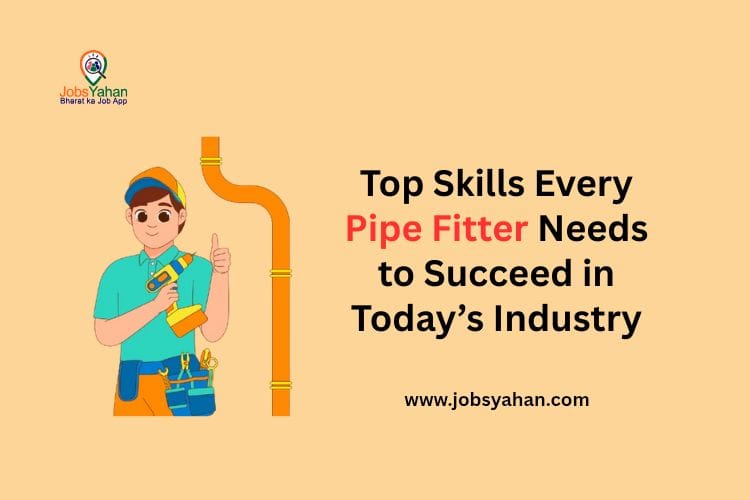
Pipe fitting careers are the ones that have been affected by the trend in industrial and construction sectors and are now more vital than ever. Yet, pipe fitters are the ones to lead the way in all these different establishments and ensure that everything runs smoothly. The implementation of safety regulations has also led to the modernization of industries; thus, employers are seeking professionals who not only have the basic knowledge but also possess some extra skills.
If you are going to search for a pipe fitter jobs near me, the best skill set that you should have is what would get you to the top. Therefore, it would be good if we could look into the fundamental skills that a pipe fitter requires to be able to survive in the market of the 21st century.
1. Technical Knowledge and Blueprint Reading
If we look at the core of every pipe fitting method, we will find that it is the skill of interpreting blueprints and technical drawings. Pipe fitters should:
Understand complicated diagrams.
Recognize pipe systems, joints, and valves.
Accurately measure and cut pipes in accordance with the given specifications.
Through this skill, installations become accurate, which leads to the reduction of expensive mistakes and the enhancement of safety. In the majority of pipe fitter positions, employers give more preference to those candidates who are able to successfully transform a 2D drawing into a tangible system.
2. Welding and Cutting Skills
Nowadays a pipe fitter is often expected to weld or cut a pipe using such welding techniques as MIG, TIG, or arc welding as part of the modern projects. Mastering welding not only makes you adaptable but also very attractive to potential employers. Besides that, the good use of cutting torches and power tools is a must when it comes to handling different materials such as steel, copper, or PVC.
If you are searching for pipe fitter jobs near me, you will find that welding certifications are often mentioned as a desired qualification.
3. Knowledge of Materials and Tools
Pipe fitters can use various materials for the pipes, which can be stainless steel, copper, aluminum, plastic, etc. Every material has its own properties, which means it needs to be handled and installed in a certain way. In the same manner, the pipe fitters must be proficient with the tools that range from simple wrenches to complex hydraulic tools.
Such knowledge is what safeguards the quality and the functionality of pipe systems in all sectors, be it the water supply or the chemical processing industries.
4. Mathematical and Measurement Skills
Pipe fitting is all about accuracy. A small mistake in calculation might cause leaks, system failures, or expensive repairs. This is why the mastery of math is very important. Pipe fitters frequently have to compute:
The angles for cutting.
The dimensions for pipe bends.
The pressure requirements for systems.
The pipe fitter jobs that employers offer expect candidates to be good at calculations, fractions, and geometry.
5. Working as a pipe fitter means performing exhausting physical activities.The work is often slow and arduous; professionals are expected to spend several hours carrying pipes, compacting in tight spaces, and even hanging up on a ladder. In the meantime besides the strength, good hand-eye coordination is very important for the execution of tasks such as threading, cutting, and welding.
Pipe fitter jobs local to me, if that is what pipe fitter career is, will require me to have both the skill and the stamina for the job.
6. Problem-Solving and Critical Thinking
The only way to "fix" an installation or a repair is to have Ifixers discovering unexpected issues. For instance, what if pipes have been installed in a wrong way and there is a sudden breakdown of equipment? Just the right way to solve these problems is what pipefitters ought to do. The qualities that employers put in front are problem-solving, analyzing issues within the shortest time, and coming up with solutions that are both safe and practical.
Not only this ability helps stay on track with the schedule but it also credits a pipe fitter as a dependable friend to the team.
7. Safety Awareness
The pipe fitting sector is an industry with lots of risks, including high pressure exposure, fire or even small spaces. Hence, comprehending the safety standards is the only possible deal. Pipe fitters shall:
Comply with either OSHA or local safety rules.
Put on proper safety gear.
Do a risky/incidence prevention assessment before starting their work.
The majority of pipe fitter positions highly emphasize safety training since it is crucial for the protection of the workers as well as the safety of the part of the building that is being worked on.
8. Communication and Teamwork
In piping, upstream or downstream, collaborative effort is the norm of the day, rather than working alone. The collaborators in question are engineers, welders, plumbers, and project managers, among others. Hence there will be coordination and communication, so that all the parties are aware of the same facts. Thus the room for mistakes is very little.
If an individual is in a position to list pipe fitter jobs that are in my area, then confidence in teamwork and communication can significantly increase the chances of getting employed.
9. Adaptability to New Technologies
With the modernization of industries through the use of automation, digital tools, and new fabrication methods, the modern pipe fitters have to keep up with technological advances. Greeting the laser measuring devices, CAD software, or automated welding systems with open arms might just give you in-job market the leading edge.
Today adaptability is a major factor that a potential employer would look at while hiring for pipe fitter jobs.
10. Continuous Learning and Certification.
Most successful pipe fitters willingly and continuously pursue further education.
Along the way, one may also take a welding training, sign up for the OSHA safety code classes, or opt for the particular pipe fitting courses just to mention a few. Besides that, going to conferences and taking up workshops is also a way of staying up-to-date with the changes in the industry.
If a candidate for a pipe fitters job is actively applying and is looking for positions near him, then certification will often be the deciding factor in the shortlisting of his application.
Career Outlook for Pipe Fitters
The need for the services of a skilled pipe fitter is not going to dwindle soon; on the other hand, it is going to grow as a result of new infrastructure projects, industrial expansion, and the need for routine system maintenance. In line with reports from the industry, a steady increase in job openings is believed to be the case in such sectors as:
Oil and gas.
Power plants.
Water treatment facilities.
Construction and real estate.
Piper fitters can enjoy stable and fulfilling jobs if they possess the required technical and soft skills.
Final Thoughts
The major components that make one a successful pipe fitter are not only the manual skills but the fusion of technical knowledge, problem-solving skills, and absolute observance of safety regulations. If you are a seasoned professional or just embarking on your career, working on these top skills will keep you ahead in today’s gig market.